Click the icon below to explore our YouTube channel for practical lessons and ideas.

CBSE’s New 3-Language Rule: What R1, R2, and R3 Actually Mean for Your Child.
This blog offers a comprehensive exploration of the CBSE three-language policy, tracing its origins from the 1968 National Education Policy under Indira Gandhi to its modern alignment with NEP 2020. It explains the structured framework of R1, R2, and R3, where students must study three distinct languages between Classes 6 and 10, with the stipulation that at least two must be Indian. The blog highlights how this shift redefines English as a foreign language rather than the default second language, sparking widespread debate. Through clear analysis, the blog examines the practical challenges faced by parents, teachers, and school administrators—from the squeeze on foreign languages like French and German, to the shortage of qualified regional language teachers, and the growing anxiety over subject load. It also raises critical questions about balancing cultural pride with global practicality, asking whether the policy strengthens India’s linguistic identity at the cost of limiting international opportunities. At the same time, the blog provides practical advice for families, encouraging parents to choose languages based on interest and resources, focus on communication rather than marks, and engage with schools to understand available options. The final verdict acknowledges the policy’s bold vision of making India “Atmanirbhar” in language, while stressing the need for better textbooks, more teachers, and greater flexibility. Ultimately, this blog invites readers to reflect: Is the policy a meaningful way to reconnect with our roots, or does it risk placing too much pressure on students in an already demanding academic environment?
EDUCATION POLICY & SOCIETYPARENTING RESOURCESYOUTH & CAREER SKILLSTEACHING & LEARNINGEDUCATIONSTUDENT CHALLENGESLANGUAGE LEARNING
J R Nanda | EngQuest Hub
4/21/20265 min read
The three-language policy introduced by CBSE has sparked widespread concern among parents, teachers, and school administrators. This reaction is not surprising—any major shift in educational policy tends to generate both curiosity and apprehension. The policy challenges long-standing practices by restructuring the language framework into R1, R2, and R3, with the stipulation that at least two of the three languages must be Indian.
For many stakeholders, the implications are significant:
Parents worry about the added academic burden and the future relevance of certain languages.
Teachers face the challenge of adapting curricula, teaching methods, and assessment strategies to align with the new framework.
School administrators must grapple with logistical issues such as staffing, resource allocation, and compliance with CBSE guidelines.
The debate stems from the fact that English, traditionally treated as the second language, is now categorized as a foreign language. This reclassification alters the balance between global utility and national identity, raising questions about how students will navigate higher education and career opportunities in a globalized world.
In the following discussion, we will delve deeper into the rationale, challenges, and potential outcomes of this policy to understand its impact more clearly.
What are R1, R2 and R3?
In the CBSE three-language policy, aligned with the National Education Policy (NEP) 2020, the terms R1, R2, and R3 denote three distinct levels of language study. These are not merely labels but represent a structured framework for linguistic proficiency and cultural integration.
R1 (Primary Language): The home language or mother tongue, forming the foundation of a student’s linguistic identity.
R2 (Secondary Language): A second language, chosen to broaden communication and cultural exposure.
R3 (Third Language): An additional language, ensuring diversity and multilingual competence.
The core principle of this framework is that at least two of the three languages must be native to India, and the same language cannot be repeated across levels. Beginning with the 2026–2027 academic session, students from Class 6 to 10 will be required to study three distinct languages under this model.
This approach is designed to strengthen Indian languages, while still allowing space for global languages like English, which is now categorized as a foreign language rather than automatically being treated as the second language. The policy thus seeks to balance national identity with international relevance, encouraging students to embrace multilingualism in a structured and equitable way.
Let’s understand this with an example here. If students are enrolled in an English-medium school, they cannot simply opt for English, French, and Spanish as their three languages. Under the CBSE framework, at least two of the three must be Indian languages—such as Hindi, Sanskrit, Tamil, Marathi, Bengali, or others. This ensures that while students may still study a foreign language, the policy firmly prioritizes the promotion and preservation of India’s linguistic heritage.
The Timeline: When Does the Clock Start?
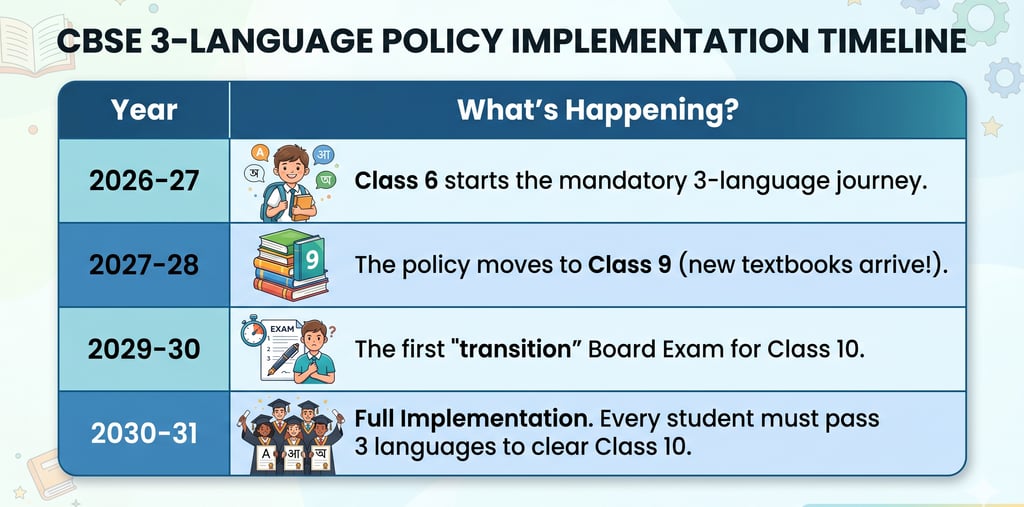
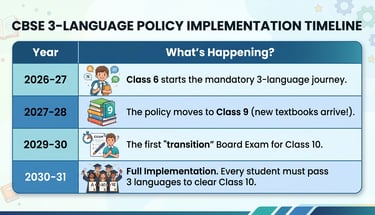
As of April 2026, the first phase of the CBSE three-language policy is officially rolling out for Class 6 students. This marks the beginning of the transition, but its full impact will unfold gradually. The Board Examination implications are designed as a slow burn—students entering Class 6 this year will carry the new framework forward, and its effects will only become visible in the Board Exams several years later.
This phased approach ensures that schools, teachers, and students have time to adapt, while also signalling a long-term shift in how language learning is structured in India’s education system.
Where does the Trouble Start?
No major reform comes without hurdles, and the CBSE three-language policy is no exception. The challenges are already surfacing across schools, parents, and administrators:
The “Foreign Language” Squeeze
This is the most pressing concern for many parents. With the rule that two languages must be Indian, foreign languages such as French, German, or Japanese are being sidelined. Since English is often the first choice, these global languages are losing their place in the core curriculum. For students aspiring to study abroad or work in international sectors, this feels like a setback. Schools are attempting to relegate foreign languages to “hobby clubs”, but everyone knows that extracurricular exposure cannot replace the rigor of a core subject.
Where Are the Teachers?
The logistics are daunting. Imagine a school in Lucknow deciding to offer Malayalam as a third language—where do they suddenly find a qualified teacher? The reality is a shortage of trained regional language educators, especially in states where those languages are not commonly spoken. This gap threatens the smooth implementation of the policy.
The “Subject Load” Anxiety
Students are already balancing Math, Science, Social Studies, and emerging subjects like AI and vocational courses. Adding a third language—with its own grammar, literature, and examinations—feels like stacking another heavy brick onto an already overloaded school bag. The fear of burnout and reduced focus on other subjects is real, and parents are voicing concerns about the overall academic burden.
A Critical Look: Cultural Pride vs. Global Practicality
The central question remains: Are we prioritizing sentiment over skills? In 2026, the world is more interconnected than ever before. While it is enriching to learn classical languages like Sanskrit or regional ones like Tamil, we cannot overlook the fact that Mandarin, Spanish, and German dominate the arenas of global trade, diplomacy, and technology. By mandating that students choose at least two Indian languages, are we inadvertently narrowing the horizons of those who aspire to become global diplomats, entrepreneurs, or professionals in international markets?
Another concern is the risk of tokenism. If students are compelled to study a third language merely to clear an exam, the learning often becomes mechanical. Once the exam is over, the language is forgotten. True language education must go beyond memorizing grammar rules or writing essays in a three-hour test—it should cultivate the ability to speak, communicate, and engage meaningfully in real-world contexts.
The challenge, therefore, is to strike a balance: celebrating cultural pride through Indian languages while ensuring global practicality for students who will step into an increasingly borderless world.
So, what should you do if your child is entering Class 6 or 9 this year?
Don’t Panic: Choose the third language based on interest and availability. If your child shows a natural flair for it, that’s ideal. If not, select a language with plenty of accessible resources—such as YouTube tutorials, online courses, or local tutors.
Focus on Communication: Encourage your child to speak the language at home or with friends. Marks matter, but fluency and confidence in real-life use are far more valuable.
Check the School’s Options: Not every school offers every language. Sit down with the principal or administrators to understand which Indian languages are supported and how they fit into the CBSE framework.
Final Verdict
The CBSE three-language policy is a bold attempt to reclaim India’s linguistic identity. It reflects an ambitious vision of making India “Atmanirbhar” even in the way we speak.
However, for this policy to truly succeed, the government must:
Provide better textbooks and teaching materials
Recruit and train more qualified language teachers
Offer greater flexibility in balancing Indian and foreign languages
One thing is certain: the Class 10 Board Exams of 2031 will look very different from the ones we wrote.
Closing Thought
This raises a larger debate: Is the policy a powerful way to stay connected to our roots, or does it risk placing too much pressure on students? The answer may lie in how effectively schools, parents, and policymakers work together to balance cultural pride with global practicality.