Click the icon below to explore our YouTube channel for practical lessons and ideas.
Don’t Outsource Your Brain: Finding Balance in the Age of AI
This blog addresses the growing concern of over-reliance on Artificial Intelligence in educational and professional settings. Drawing inspiration from a Times of India article , it explores how tools like ChatGPT can lead to "robotic" thinking and the erosion of critical problem-solving skills. It highlights several key themes: The Struggle of Learning: Using the metaphor of a muscle, the author argues that the "struggle" of thinking is essential for neurological and linguistic growth. Case Studies and Research: It references the story of a student named Sachi who lost her ability to explain her own work and cites a study by the MIT Media Lab regarding the negative impact of AI reliance on brain engagement. The Indian Context: The article discusses the specific risks of using foreign-built AI models in India, such as cultural bias and the potential for a widened digital divide. Practical Frameworks: To promote healthy AI usage, it suggests strategies like the Feynman Technique for conceptual understanding and the 80/20 Rule, where 80% of the core thinking is done by the human. Ultimately, the blog serves as a call to action for the Engquest Hub community to treat AI as an enabler rather than a replacement, urging readers to maintain their unique human perspective and curiosity.
DIGITAL PARENTINGDIGITAL LITERACYSTUDENT CHALLENGESSKILL DEVELOPMENTLANGUAGE LEARNING
J R Nanda | EngQuest Hub
4/12/20263 min read
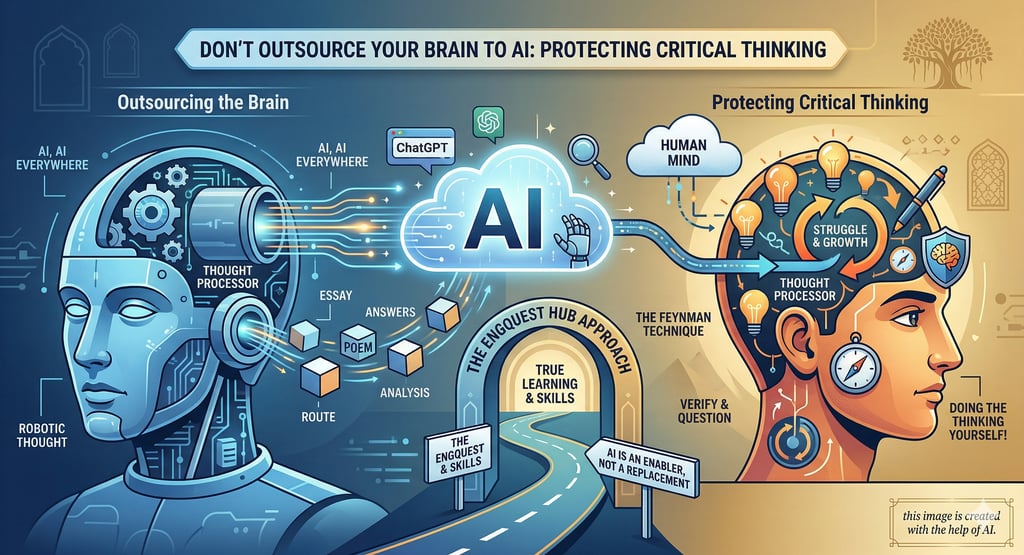
Nowadays, it is "AI, AI everywhere". Whether you are a student or a professional, everyone is talking about ChatGPT. But is this magic tool helping us grow, or is it simply making our brains lazy? Whether you are ordering food, finding a route, writing an essay, or even composing a poem for a friend, you are just one click away from an answer. At first, it feels like a panacea for all our problems. However, as we use these tools more frequently, a vital question arises: Are we using AI to enhance our minds, or are we letting AI replace them?
I recently came across an insightful article by Joeanna Fernandes in The Times of India (4th April 2026) titled "Don’t Outsource Your Brain to AI". It resonated deeply with our mission at Engquest Hub, and I wanted to share my perspective on why we must protect our critical thinking in this AI age.
The Journey of the Mind
At Engquest Hub, we believe that learning a language or any new skill is about the journey of the mind. Lately, there has been a worrying trend where students and professionals are "outsourcing" their thinking to machines. This isn't just about laziness; it’s about the erosion of our ability to think, create, and solve problems.
Take the story of "The Automatic Student". In Fernandes' article, she discusses Sachi, a 14-year-old student who—like many of her peers—began using platforms like Claude, Perplexity, and ChatGPT as her first option for schoolwork. Sachi admitted that she used AI so frequently that she stopped thinking for herself. Her thought process became robotic, losing the creativity and unique perspective she once had. Everything seemed fine until her English teacher asked her to explain an analysis she had submitted; Sachi went blank because the AI had done all the thinking for her.
Many of us are in the same position. We may not have faced a situation where we are forced to defend our AI-assisted work yet. But the question remains: Can we explain our own writing?. This is the trap. When we stop struggling with a difficult sentence or a complex idea, we stop growing. Critics call this the death knell of critical thinking.
Why Our Brains Need the "Struggle"
Think of your brain as a muscle. If you go to the gym just to watch someone else lift weights, your muscles won't grow. You have to lift them yourself. The "struggle" of thinking is exactly where learning happens.
A study by the MIT Media Lab found that students who relied heavily on ChatGPT performed worse neurologically and linguistically compared to those who used traditional search engines or no tools at all. Why? Because the AI users weren't engaging their brains; they were merely copy-pasting. Neurologists note that young brains are "neuroplastic," meaning they are still being shaped by their activity. If the process of researching and reflecting stops, those critical parts of the brain may not fully develop. We can see a simple parallel in the pre-cell-phone era: people used to remember dozens of phone numbers, but today, we hardly remember any.
The Indian Context: A New Challenge
In India, education is the ladder to a better life. We have millions of bright students, but there is a risk. If we rely too much on AI models built elsewhere, we might lose our local voice. These models often carry the biases and cultural viewpoints of their creators. For a diverse country like ours, we must ensure AI bridges gaps for marginalized communities rather than creating a new "digital divide" where only those who know how to "prompt" get ahead.
How to Use AI Without Losing Yourself
We shouldn't ban AI; it is a powerful tool, much like a calculator. The key is how we use it. Here are some guidelines for the Engquest Hub community:
The Feynman Technique: Instead of asking AI to write for you, ask it to explain a concept as if you were five years old. Once you understand it, write the content in your own words.
The 80/20 Rule: Do 80% of the work yourself—the thinking, the structure, and the main points. Use AI for the final 20%, such as checking grammar or finding a synonym.
Verify and Question: AI can "hallucinate" or make things up. Never take its word as final truth; always check the facts.
For Parents and Teachers: Focus on the process, not just the result. If a child produces a perfect essay, ask them why they chose a certain argument. Praise the thinking, not just the grade.
Final Thoughts
AI is an enabler, not a replacement. It can give you a head start, but you are the one who must run the race. Don't let your brain become a "relay station" for a machine. Use your own words, your own mistakes, and your own unique style. That is what makes you human. Let’s use technology to become smarter, not to stop being thinkers.