Click the icon below to explore our YouTube channel for practical lessons and ideas.

From Law to Reality: Reforming India’s Child Protection System under the Juvenile Justice Framework
India’s child protection system is guided by the progressive Juvenile Justice (Care and Protection of Children) Act, 2015, strengthened through the Juvenile Justice (Care and Protection of Children) Amendment Act, 2021 and the operational framework provided by the Juvenile Justice Model Rules, 2016. Together, these laws aim to protect vulnerable children, rehabilitate children in conflict with law, and promote family-based care through systems such as Child Welfare Committees, Juvenile Justice Boards, and Child Care Institutions. Despite the strong legal framework, significant gaps remain between policy intent and grassroots implementation. Across many districts in India, child protection mechanisms struggle with institutional shortages, vacancies in Juvenile Justice Boards and Child Welfare Committees, delays in case disposal, and limited availability of trained social workers. Infrastructure deficits—such as the absence of specialized facilities and “places of safety” for juveniles—further weaken the system’s effectiveness. This research-based blog examines how India’s juvenile justice framework functions in practice. Drawing on policy analysis, government reports, and social sector insights, it explores key bottlenecks including weak data systems, inadequate monitoring, and limited community awareness of foster care and sponsorship programs. The article also highlights the urgent need for stronger coordination between government agencies, social workers, and civil society organizations. From a social work perspective, strengthening child protection requires not only better laws but also effective institutional capacity, trained professionals, and active community participation. By addressing these systemic challenges, India can move closer to building a child protection ecosystem that truly safeguards the rights, dignity, and future of vulnerable children. Keywords: juvenile justice system India, child protection policy India, JJ Act 2015 analysis, child welfare committees India, juvenile justice implementation challenges, social work and child rights India.
CHILD PRTECTION IN INDIAJUVENILE JUSTICE SYSTEMSOCIAL WORK & CHILD WELFARECHILDREN IN NEED OF CARE AND PROTECTION (CNCP)CHILDREN IN CONFLICT WITH LAW (CICL)PUBLIC POLICY & LAWSOCIAL ISSUESCOMMUNITY DEVELOPMENTFAMILY STRENGTHENING
J R Nanda | EngQuest Hub
3/17/20265 min read
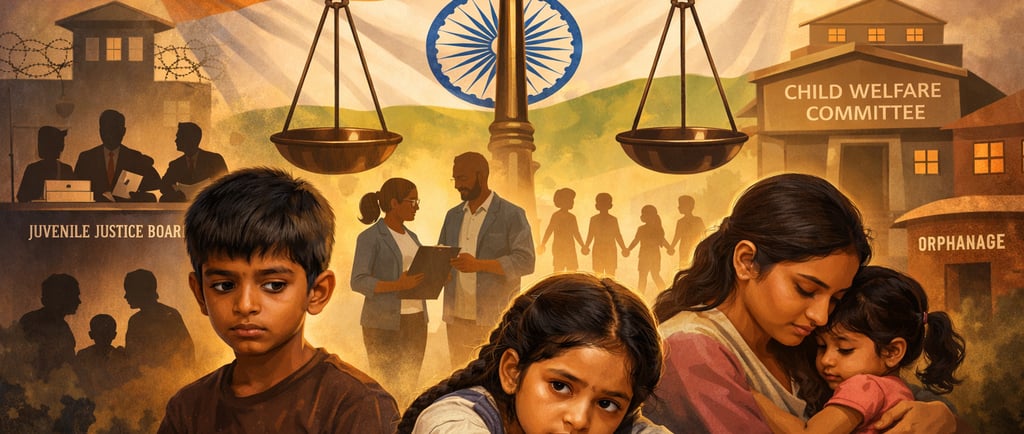
India has one of the most progressive legal frameworks for child protection in the Global South. The Juvenile Justice (Care and Protection of Children) Act, 2015, strengthened by the Juvenile Justice (Care and Protection of Children) Amendment Act, 2021 and operationalized through the Juvenile Justice Model Rules, 2016, provides a comprehensive system for protecting vulnerable children and rehabilitating children who come into conflict with the law.
The framework is designed to ensure that children are treated not as offenders but as individuals capable of reform and reintegration. It establishes institutions, procedures, and care mechanisms to uphold the principles of rehabilitation, child rights, and restorative justice.
However, despite this strong legislative foundation, the gap between policy and practice remains significant. Evidence from national reports, field studies, and administrative data reveals serious bottlenecks in implementation at the grassroots level. From the perspective of social work and child protection practice, the challenge lies not in the absence of laws but in the weak functioning of the systems responsible for implementing them.
Understanding the Juvenile Justice Framework:
The Juvenile Justice system recognizes two major categories of vulnerable children:
Children in Conflict with Law (CICL) – minors accused or found to have committed offences.
Children in Need of Care and Protection (CNCP) – children who are abandoned, abused, homeless, trafficked, or otherwise vulnerable.
To address the needs of these children, the law establishes multiple institutions and mechanisms, including:
Juvenile Justice Boards (JJBs) to adjudicate cases involving CICL.
Child Welfare Committees (CWCs) to handle cases involving CNCP.
Child Care Institutions (CCIs) such as observation homes, special homes, children’s homes, and places of safety.
Non-institutional care mechanisms, including foster care, sponsorship, adoption, and aftercare programs.
The 2021 amendment introduced stricter qualifications for members of CWCs and strengthened district-level oversight by empowering District Magistrates to monitor child care institutions and committee functioning.
The Model Rules of 2016 provide detailed operational guidelines for foster care placement, institutional standards, inspection protocols, and case management procedures.
On paper, this framework aligns closely with international standards such as the UN Convention on the Rights of the Child, emphasizing rehabilitation, family-based care, and the best interests of the child.
Implementation Gaps - The Ground Reality:
Despite progressive legislation, implementation remains uneven across states and districts. Several systemic challenges continue to weaken the effectiveness of the child protection system.
1. High Pendency of Cases
One of the most pressing concerns is the backlog of cases in Juvenile Justice Boards.
Recent national assessments reveal that approximately 55% of cases before JJBs remain pending, leading to significant delays in justice delivery. These delays undermine the rehabilitative purpose of juvenile justice, as children often remain in institutional care while their cases are unresolved.
Long waiting periods can disrupt education, emotional well-being, and social reintegration for affected children.
2. Inadequate Infrastructure
Infrastructure shortages continue to undermine effective implementation.
Studies show that only a small fraction of districts have the minimum required set of juvenile justice institutions, including functional boards, committees, and child care facilities.
Particularly concerning is the absence of “places of safety” for children aged 16–18 accused of serious offences in several states. Without such facilities, juveniles are often housed in inappropriate or overcrowded institutions.
Another critical gap is the shortage of institutions for girls, with only a limited number of specialized facilities available nationwide. This reflects broader gender disparities in child protection infrastructure.
3. Shortage of Trained Human Resources
Human resource deficits are a major challenge in the juvenile justice system.
Many districts struggle with vacancies in CWCs and JJBs, and some committees operate without the full complement of members. Even when positions are filled, members may lack specialized training in child psychology, social work, or juvenile justice procedures.
Furthermore, probation officers, counselors, and trained social workers are often insufficient in number. This affects the preparation of social investigation reports, individual care plans, and rehabilitation strategies, which are central to the child-centered approach of the law.
4. Weak Data Systems and Monitoring
Reliable data is essential for monitoring child protection systems, yet data management in the juvenile justice sector remains fragmented.
Although digital portals exist for tracking children in care, their implementation varies widely across states. Many oversight bodies lack access to real-time information on institutional capacity, case progress, or rehabilitation outcomes.
This creates an accountability gap, where policymakers and administrators struggle to identify systemic failures or measure the effectiveness of interventions.
5. Limited Use of Family-Based Care
While the law prioritizes family-based care over institutionalization, such alternatives remain underutilized.
Foster care programs are operational in only a few states, and sponsorship schemes reach relatively small numbers of vulnerable families. Social stigma and limited awareness discourage community participation in child care initiatives.
As a result, many children continue to be placed in institutional care even when family-based alternatives might be more beneficial.
Structural Causes Behind the Implementation Gap:
From a social science perspective, these challenges arise from deeper structural issues.
First, child protection often receives limited administrative priority compared to sectors like health or education. As a result, budgets, staffing, and institutional capacity remain inadequate.
Second, coordination among stakeholders—including police, social welfare departments, judiciary, and civil society organizations—is frequently weak. Without integrated systems, children may fall through institutional gaps.
Third, professionalization of child protection services remains incomplete. Although the law emphasizes expertise in child development and social work, training programs are inconsistent and insufficient.
Finally, community participation in child protection remains limited, reducing the effectiveness of preventive interventions and alternative care models.
Policy and Practice Reforms Needed:
Bridging the gap between law and implementation requires multi-dimensional reforms.
Strengthening Institutional Capacity:
Governments must prioritize filling vacancies in Juvenile Justice Boards and Child Welfare Committees. Mandatory training in child rights, trauma-informed care, and rehabilitation practices should be provided regularly to all members.
Recruiting trained social workers and probation officers at the district level is essential to ensure effective case management.
Expanding Infrastructure:
States must ensure the availability of essential child protection infrastructure, including observation homes, special homes, and places of safety.
Particular attention should be given to establishing gender-sensitive institutions for girls, who remain underserved within the current system.
Building Integrated Data Systems:
Developing a centralized digital child protection data system would allow real-time tracking of cases, institutional placements, and rehabilitation outcomes.
Improved data transparency would enable policymakers to monitor performance and identify areas requiring intervention.
Promoting Non-Institutional Care:
Public awareness campaigns should promote foster care, adoption, and sponsorship programs. Financial incentives and support services could encourage families and communities to participate in alternative care initiatives.
Reducing unnecessary institutionalization should remain a key priority.
Encouraging Community Participation:
Local communities, schools, and civil society organizations should play a stronger role in identifying vulnerable children and supporting rehabilitation efforts.
Community engagement is crucial for building a sustainable child protection ecosystem.
Conclusion - Bridging the Policy–Practice Divide:
India’s juvenile justice framework represents a forward-looking approach to child protection, rooted in the principles of rehabilitation, dignity, and the best interests of the child.
Yet the effectiveness of this system ultimately depends on how well it functions at the grassroots level.
From a professional social work perspective, the challenge lies in transforming strong legislation into effective institutional practice. Addressing infrastructure shortages, human resource gaps, weak monitoring systems, and limited community engagement is essential to achieving this goal.
If these systemic challenges are addressed through sustained political commitment and administrative reform, India’s juvenile justice system can evolve into a model for child protection worldwide.
Until then, bridging the gap between law and lived reality remains one of the most pressing priorities in the field of child welfare and social justice.
