Click the icon below to explore our YouTube channel for practical lessons and ideas.

Supreme Court Verdict on Menstrual Leave: A Balanced Review
This blog critically analyzes the Supreme Court of India’s recent decision to reject a petition for compulsory menstrual leave for women, as reported by NDTV. It explores the nuanced arguments presented by Chief Justice Surya Kant and Justice Joymalya Bagchi, who expressed concerns about employment discrimination, psychological impact, and business feasibility. The post also highlights counterpoints raised by the petitioner and Senior Advocate MR Shamshad, including Kerala’s progressive policy and voluntary corporate practices. Set against the backdrop of the Court’s earlier ruling recognizing menstrual hygiene as a constitutional right under Article 21, the blog offers a balanced perspective on the complex intersection of gender justice, legal mandates, and workplace realities. It concludes with constructive suggestions for voluntary adoption, awareness campaigns, and flexible accommodations, while inviting readers to share their views on how India should move forward.
LAW & JUDICIARYGENDER EQUALITYWORKPLACE & EMPLOYMENTHEALTH & WELL-BEINGPOLICY & GOVERNANCESOCIAL JUSTICE & RIGHTS
J R Nanda | EngQuest Hub
3/13/20262 min read
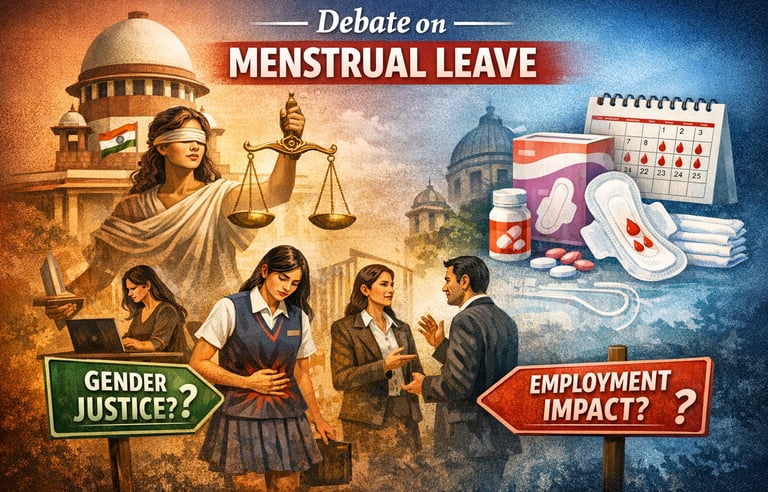
NDTV recently reported on the Supreme Court’s rejection of a petition seeking compulsory menstrual leave for women, whether students or working professionals. The plea, filed by lawyer Shailendra Mani Tripathi, asked the Court to direct states to frame rules for paid menstrual leave.
Chief Justice Surya Kant and Justice Joymalya Bagchi, however, raised strong reservations. They cautioned that such a law could adversely affect women’s employment prospects, as employers might avoid hiring women altogether. The Court also warned that compulsory leave could unintentionally reinforce stereotypes, creating a perception that women are “less” capable than men. Justice Bagchi further highlighted the business feasibility angle, noting that employers often view human resources through a competitive lens, and compulsory leave could make female employees appear “unattractive” in the job market.
Counterpoints and Precedents
Senior Advocate MR Shamshad pointed out that Kerala has already granted menstrual leave to women students in state-run universities since 2013, framing it as part of building a gender-just society. He also noted that several private companies voluntarily offer menstrual leave, showing that progressive policies can coexist with business interests.
Importantly, the Court itself, in January, recognized menstrual hygiene as an integral part of Article 21—the right to life, dignity, health, and education. That ruling mandated governments to provide free sanitary napkins, gender-segregated toilets, and awareness campaigns. This precedent underscores that menstrual health is not just a private matter but a constitutional concern.
Balancing Gender Justice and Practical Realities
The debate highlights a tension between gender equity and economic pragmatism. On one hand, compulsory menstrual leave could normalize menstruation as a health issue rather than a stigma. On the other, rigid laws risk reinforcing biases and discouraging employers from hiring women.
A more balanced approach could include:
Voluntary adoption of menstrual leave policies by institutions and companies.
Awareness campaigns to reduce stigma and normalize menstruation in workplaces and schools.
Flexible accommodations such as work-from-home options or academic adjustments during menstruation.
Strengthening infrastructure under Article 21—ensuring menstrual hygiene facilities and health support are universally accessible.
The Supreme Court’s caution reflects real-world concerns about employment discrimination. Yet, the broader goal of gender justice requires creative solutions. Instead of compulsory leave, India could focus on incentivizing progressive employers, supporting women’s health infrastructure, and normalizing menstruation through education and dialogue.
This verdict raises a crucial question: should menstrual leave be a legal right or a progressive choice left to institutions and employers?
To make this discussion more accessible, we have also prepared a video presentation in Hindi. It is intended as a companion resource to the blog, allowing readers to engage with the issue in their preferred language and gain additional clarity.
