Click the icon below to explore our YouTube channel for practical lessons and ideas.

Toxic Environments and Ageing: What Indian Society Needs to Understand
A news report titled “Stressful, toxic people in your life may make you age faster, say researchers,” published in The Times of India on 10 March 2026 by Anuja Jaiswal, highlights a scientific study showing how stressful relationships can influence our biological ageing. The study, published in the journal Proceedings of the National Academy of Sciences, explains how individuals who regularly create emotional strain—referred to as “hasslers”—may gradually accelerate the body’s ageing process through chronic stress. The YouTube video shared below explains this research in a simple and engaging way and is worth watching for anyone interested in understanding how relationships affect our physical and mental health. Building on the insights discussed in the video and the newspaper report, this blog goes a step further. It examines how toxic environments operate within the Indian social context, where family expectations, workplace pressure, social comparison, and cultural norms often create persistent emotional stress. Drawing from scientific findings and real-life situations, the blog explores how toxic interactions can affect stress levels, why prolonged emotional strain may influence biological ageing, and most importantly, what individuals can do to respond wisely. It also offers practical and realistic strategies for maintaining healthier relationships, setting boundaries, and protecting long-term well-being in environments that may not always be easy to change.
HEALTH & WELL-BEINGPSYCHOLOGY & BEHAVIOURMENTAL HEALTH AWARENESSPERSONAL DEVELOPMENT
J R Nanda | EngQuest Hub
3/12/20262 min read
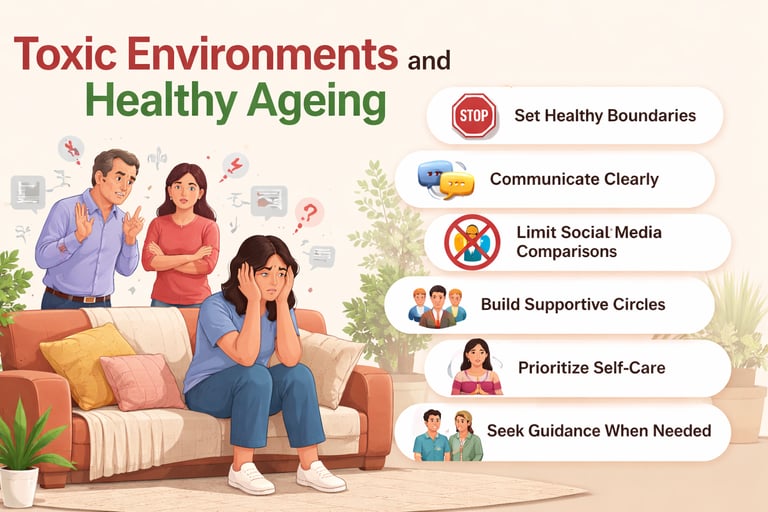
Recent research suggests that stressful relationships may accelerate biological ageing (Courtesy: The Times of India, 10 March 2026). Scientists have found that persistent emotional strain can increase stress hormones in the body, which may gradually affect cellular health. While this research is global, its relevance becomes even clearer when we look at everyday social environments in India. Many people live within relationship structures where stress, criticism, or pressure has become normalized.
In India, relationships are deeply rooted in family and community systems. These systems often provide strong emotional support, but they can also create environments where individuals constantly face judgement, comparison, or pressure. Such environments can quietly affect mental and physical well-being.
One common example is constant comparison within families. Many young people grow up hearing statements such as, “Look at your cousin; he already has a government job,” or “Your neighbour’s daughter scored higher marks.” Over time, such comparisons create anxiety, self-doubt, and emotional stress.
Another example is the workplace culture in many sectors. Long working hours, unrealistic expectations, and lack of appreciation often create high-stress environments. Employees may feel pressured to prove themselves constantly, sometimes facing harsh criticism rather than constructive feedback.
Social media has also introduced a new layer of emotional strain. Platforms such as Instagram and Facebook expose people to carefully curated lifestyles. When individuals repeatedly compare their real lives with these idealized images, they may experience feelings of inadequacy or dissatisfaction.
Family dynamics can sometimes become another source of stress. In some households, younger members may not feel comfortable expressing their opinions, especially regarding career choices, marriage, or lifestyle decisions. The fear of disappointing family members can create silent emotional pressure that persists for years.
These everyday situations may not seem extreme, but when such stress continues for long periods, the body remains in a prolonged “alert mode.” This means stress hormones like cortisol stay elevated. Over time, this can influence sleep quality, metabolism, immunity, and even the biological ageing process.
However, the solution is not to cut off relationships or isolate ourselves. Human beings need supportive social connections for emotional and physical health. Instead, the focus should be on creating healthier relationship boundaries and communication patterns.
Here are some practical steps individuals can take:
1. Set Healthy Boundaries
Not every comment or expectation deserves your emotional energy. It is acceptable to politely decline conversations or behaviours that repeatedly cause stress.
2. Communicate Clearly
Many conflicts arise because people do not express their feelings honestly. Calm and respectful communication can often reduce misunderstandings.
3. Limit Social Media Comparisons
Remember that social media usually shows highlights, not reality. Limiting time spent on such platforms can help maintain emotional balance.
4. Build Supportive Circles
Invest time in relationships that encourage growth and mutual respect. A few positive relationships can significantly reduce stress.
5. Prioritize Self-Care
Regular exercise, good sleep, and personal reflection help the body manage stress more effectively.
6. Seek Guidance When Needed
Sometimes professional counselling or mentorship can help individuals manage relationship stress more constructively.
India’s social culture values relationships and community bonds. These strengths should be preserved, but they must also evolve. Respectful communication, empathy, and emotional awareness are essential for building healthier environments.
If we learn to nurture relationships that support rather than drain us, we not only improve our mental health but may also protect our bodies from the long-term effects of chronic stress. Healthy relationships, in the end, are not just emotionally rewarding—they are also an investment in a longer and healthier life.
